

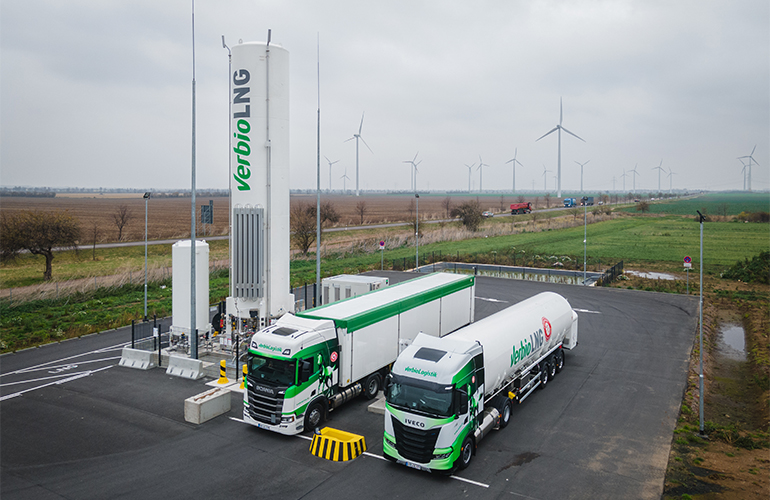
In Germany, independent biodiesel, ethanol, and biogas major, VERBIO Vereinigte BioEnergy AG (VERBIO), has commissioned Hitachi Zosen Inova BioMethan GmbH, a subsidiary of Switzerland-headed cleantech major Hitachi Zosen Inova AG (HZI), to construct a gas upgrading plant for purifying and liquefying biomethane at its Zörbig biorefinery in Saxony-Anhalt.
Please reload the page
Do you want to read the whole article?
- Six editions per year
- Full access to all digital content
- The E-magazine Bioenergy international
- And more ...
VERBIO has been producing biomethane (aka renewable natural gas – RNG) at this location since 2011. At the Zörbig biorefinery, the RNG is produced exclusively from residues from the ethanol plant and used as biofuel for natural gas vehicles (NGVs).
As a vehicle fuel, RNG reduces fossil carbon dioxide (CO2) emissions by at least 90 percent compared to diesel and petrol (gasoline) and is suitable for powering cars, trucks, and local buses.
Rising electricity, natural gas, and oil prices and the adoption of substantially more ambitious 2030 climate goals for transport have been accompanied by an increase in demand for advanced biofuels such as our residue-based biomethane, said Professor Oliver Lüdtke, the VERBIO executive in charge of bioethanol and biomethane technology.
Liquefy to bioLNG
Thus far all the biomethane produced has been fed into the natural gas grid and supplied as bioCNG in gaseous form at CNG stations.
In the future, the biomethane is to be liquefied and offered as bioLNG. It has great potential as a fuel for long-haul heavy goods vehicles (HGVs).
In the medium term, biomethane is the only available climate-friendly alternative to diesel, especially for heavy goods vehicles. For this reason, we have set the goal, in collaboration with our expert engineering and project management partner HZI, of getting our bioLNG project in Zörbig into operation as early as 2023, Professor Oliver Lüdtke said.
Modified upgrading unit
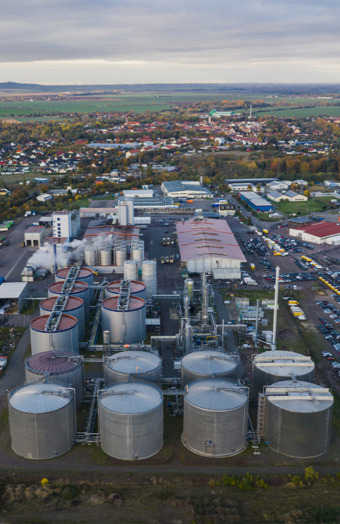
Since the biomethane used already meets the required natural gas quality standard, less CO2 has to be removed from the volume flow to upgrade it for use as a vehicle fuel.
This means that despite its smaller dimensions, the CO2 polishing unit can increase volume flows and throughput.
For the VERBIO project, Hitachi Zosen Inova’s gas upgrading technology has been modified to enable significantly higher throughput in the scrubbing tower.
The purified biomethane is then dried and fed on into the liquefaction unit.
The low concentration of CO2 in the feed gas also allows proven, standardized amine regeneration from the gas upgrading process to be deployed in compact container construction, despite the increased throughput.
HZI is thus expanding the existing A-Series with a pressure-controlled system variant for CO2 polishing.
For HZI this job is also its first joint project with VERBIO, which could be followed by more. Stefano Boscolo, Director of Sales Renewable Gas Products + Systems at HZI, is confident about the new partnership.
We’re convinced that together with VERBIO we’ll be able to meet the growing demands of the dynamically evolving energy transition by jointly implementing highly efficient, future-proof solutions ended Stefano Boscolo.
