

Bioenergy International is your brief - get full access to news and views on paper, desktop, tablet, and smartphone. Each issue is packed with easy-to-read reports and overviews as well as exclusive extras complemented by social media such as Twitter and LinkedIn.
- Download the Bioenergy International App from Apple Store or Google Store for enhanced reading on your smartphone and access to all archived issues.
- To read the current issue and/or previous issues/archived issues, as well as “Premium” content on the website, you need to log in first.
- Already a subscriber – log in here. If you have forgotten your password or haven’t activated your premium account yet, click here.
- Not a subscriber – choose your preferred subscription here.
2024
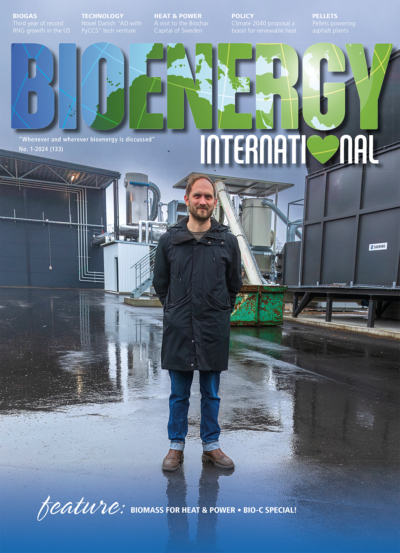
Bioenergy Int. 1-2024
The world is full of people attempting to do something or find a new way against the odds of conventional wisdom. Bioenergy conferences and trade shows are a treasure trove of people, projects, and companies that have at one point or another grasped straws, figuratively and literally, to come up with novel new solutions, like NSR’s biochar facility in Helsingborg or the folks at Stiesdal SkyClean reported on in this issue.

Bioenergy Int. 2-2024
This issue is the 10th Pellets Special, an annual Bioenergy International issue dedicated to biomass pellets. First launched in early 2015 as the companion issue to the World of Pellets Map poster, it has flourished ever since. It has always been limited to 36 pages, as together with the poster it weighs in just under a postal threshold. To mark the occasion, we’ve splashed out by adding a few more pages.
2024 Maps
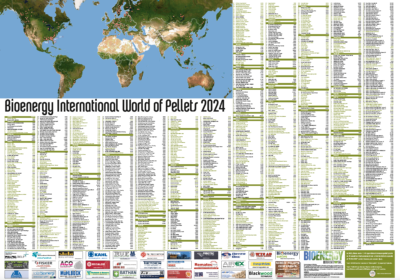
World of Pellets 2024
“World of Pellets” wall poster
The 10th edition includes site reports, a review of 2023 and outlook for 2024, pellet production technology features. In 2023, there were 1345 operational biomass pellet plants in 70 countries.
Contact us for downloading.
2023

Bioenergy Int. 1-2023 with Biochar Special
Negative emission technologies (NETs) remove carbon dioxide (CO2) from the atmosphere and transition it from the fast carbon cycle to the slow carbon cycle, also known as the “rock cycle”, indefinitely. Bioenergy lends itself exceptionally well to integration with NETs, for instance, bioenergy with carbon capture and storage (BECCS), and pyrogenic carbon capture and storage (PyCCS). These open a myriad of opportunities for both for existing- and new biomass heat- and/or power plants across almost the entire range of plant sizes. Black is the new green, bioenergy is back in black.
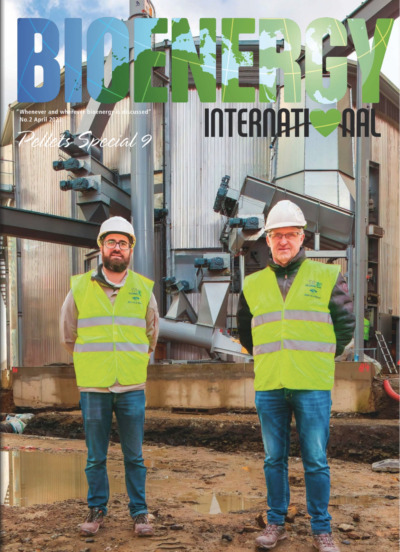
Bioenergy Int. 2-2023
Much has and can be said about the exceptionally dramatic, even traumatic (European) 2022/2023 pellet heating season that at the time of print is pretty much over.
The recent political agreement reached on the third revision of the Renewable Energy Directive (REDIII), arguably one of the most important piece of EU legislation when it comes to bioenergy, rejected the non-sensical and detrimental “primary woody biomass” notion. It is an important step in the right direction and while providing some respite, the battle of public perception is far from over.

Bioenergy Int. 3-2023
This issue goes to print as flooding in Ukraine subsides while news of Putin’s infamous Wagner paramilitary proxy had, albeit briefly, set its sights on Moscow after eighteen bloody months of failing “special operations” in Ukraine. How all this plays out remains to be seen but it is an unprecedented challenge, perceived or otherwise, to Putin’s megalomanic dictatorship – his rabid dog of war returning to bark at (or possibly bite) the now weary hand that feeds.

Bioenergy Int. 4-2023
Every year some 100,000 vessels powered by 300 million tonnes of fuel move 11 billion tonnes of goods around the world. 93.5 percent of the global fleet (by gross tonnage) operates on fossil fuels, and the balance (6.5 percent) sails on alternative marine fuels.
For aviation, global SAF production has increased remarkedly, from around 10 million litres in 2018 to a projected 1 billion litres plus by the end of 2023. Albeit a 100-fold increase, it still is just 0.1 percent of the 254 million tonnes of jet fuel burn in 2022 – military, emergency- and private aviation excluded as this issue takes a look into.

Bioenergy Int. 5-2023
This issue comes out fresh on the back of a three-week trek with back-to-back conferences, study tours, and site visits in four very different countries and regions but with one thing in common – the (bio)energy of things is moving at a seemingly increasing pace. First off was the Irish Bioenergy Association’s (IrBEA) annual bioenergy conference held in Dún Laoghaire, Co. Dublin, IrBEA’s 22nd edition and perhaps the third or possibly fourth that yours truly has attended over the years. The difference, since the last attended edition, is that eloquent rhetoric has been converted into tangible action, in multiple areas, including district- or distributed heating.
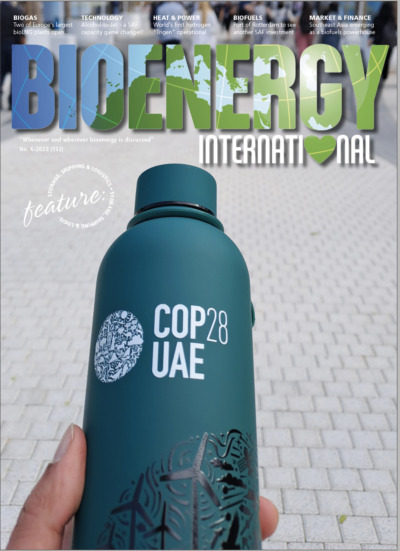
Bioenergy Int. 6-2023
The COP28 concluded just in time as this issue, the final issue for 2023 went off to print. A COP28 that has been described by many, not least of all by the organizers and host nation United Arab Emirates (UAE), as “historic”. What is historic is that it has taken 28 COPs to call out the three elephants in the room (and the reason for COP in the first place). The UAE Consensus outlined a specific target to triple renewables and double energy efficiency by 2030 and made “an unprecedented reference” to transitioning away from all fossil fuels to enable the world to reach net zero by 2050. This “unprecedented reference” might mark the beginning of the end of the fossil fuel combustion era.
2023 Maps
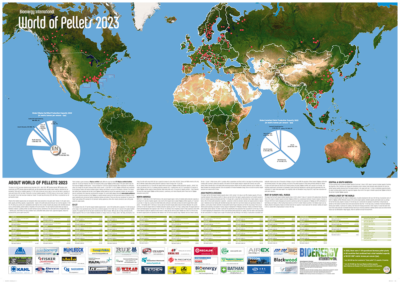
World of Pellets
“World of Pellets” wall poster
The 9th edition includes site reports, a review of 2022 and outlook for 2023, pellet production technology features. In 2022, there were 1191 operational biomass pellet plants in 64 countries.
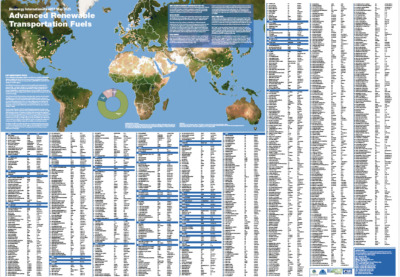
Advanced Renewable Transport Fuels
This is the fourth edition of the Bioenergy International’s Advanced Renewable Transportation Fuels (ARTF) wall poster, included as a supplement to issue 4/2023 of Bioenergy International magazine. It serves as a graphic illustration of 973 advanced renewable transportation fuel production facilities in 49 countries around the world.