

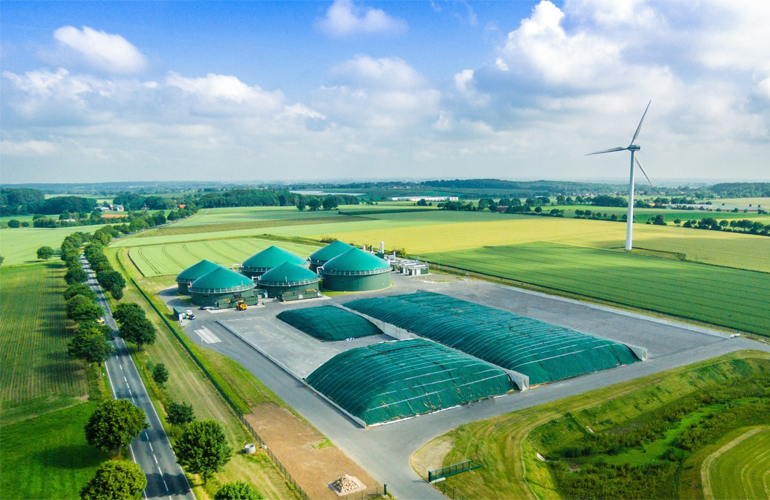
In Germany, biogas producer Bioenergie Geest GmbH & Co. KG and the Swiss cleantech company Hitachi Zosen Inova AG have formed a joint venture company in Apensen, to produce 2 000 tonnes of bioLNG from sustainably generated biogas annually by the end of 2023.
According to a statement, Bioenergie Geest and HZI signed a contract at the end of April to form the joint venture company Apensen Verflüssigungs GmbH & CO. KG.
Bioenergie Geest has been successfully operating a fermentation plant in Apensen, Lower Saxony since 2011. The plant has a biogas upgrading unit supplied by the predecessor company of HZI subsidiary HZI BioMethan GmbH.
Here biomethane is produced on the basis of renewable raw materials and fed into the grid. This classic plant design is now being further developed.
This will involve switching the substrate fed into the plant to 80 percent-plus sustainable feed materials such as slurry and manure, as well as enhancing the existing gas upgrading unit by the addition of new systems for liquefying methane and carbon dioxide (CO2).
The power for the new components is to be generated by the plant’s own existing combined heat and power (CHP) unit.
In the future, the 32 GWh/ per annum or so of sustainable raw biogas will be used to produce around 2 100 tonnes of liquefied biomethane (bioLNG) for the vehicle fuels market.
A by-product will be more than 4 000 tonnes of liquid carbon dioxide (CO2) to substitute fossil-based CO2 in industry.
Upgrading the biogas will considerably reduce greenhouse gases (GHG): it will be possible to claim and sell over 20 000 tonnes per annum of carbon dioxide equivalents (CO2eq) in the form of greenhouse gas quotas (GHG quotas) under the new German legislation.
The entire production chain is thus not only carbon neutral but has a negative carbon footprint.
GHG reduction is a business case driver
It is precisely these reductions in GHGs, calculated and traded in the form of GHG quotas, that will enable the investment in the cryogenic liquefaction technology needed for the process.
The basis for this is the EU Renewable Energy Directive (RED II), which imposes concrete obligations on member states such as making the fuel mix increasingly green.
In Germany, this target is pursued by means of greenhouse gas reduction quotas within the Federal Immission Control Act.
The law obliges distributors of fossil fuels to reduce their carbon footprint by 25 percent by 2030 in relation to 2010.
Recently this requirement has triggered considerable demand for sustainable biofuels and the associated GHG quotas.
Complementary partners
For Bioenergie Geest the new partnership marks the continuation of a successful, longstanding cooperation to produce and process biomethane.
And it all revolves around regionalism, active climate protection, and close cooperation with farmers, emphasized Sven Plorin, one of the managers of Bioenergie Geest.
From the point of view of the Zurich-based global plant engineer and technology provider HZI and its wholly-owned subsidiary HZI BioMethan (HZIBM) in Zeven, Lower-Saxony, the creation of the company with Bioenergie Geest is an important step in establishing their new gas liquefaction solutions in their home market of Germany.
For us, the circumstances in Apensen and the partnership with Bioenergie Geest is the ideal opportunity to demonstrate our expertise in liquefaction at an extremely well-run biogas plant more or less on our own doorstep, explained Jens Becker, CEO of HZI BioMethan.
The plan is to start construction on the plant in Apensen in the course of this year, enabling the production of pure bioLNG to commence towards the end of 2023.
