

In Germany, LNG filling station operator LIQVIS GmbH, and biogas plant operator and technology developer EnviTec Biogas AG (EnviTec) have announced the signing of an agreement for the supply of bioLNG. EnviTec Bioenergie Güstrow GmbH, a wholly-owned subsidiary of EnviTec Biogas, will start supplying LIQVIS with bioLNG from the third quarter of 2022.
Please reload the page
Do you want to read the whole article?
- Six editions per year
- Full access to all digital content
- The E-magazine Bioenergy international
- And more ...
Earlier this month, EnviTec revealed that it was acquiring BioEnergie Park Güstrow, one of Germany’s largest biogas plants, and repurposing the biomethane-to-grid facility to produce liquefied biomethane (LBG or bioLNG) with production expected to commence in autumn 2022.
As the bioLNG will be carbon-neutral, this will lead to a further significant reduction in carbon dioxide (CO2) emissions compared with conventional liquefied natural gas (LNG).
From October 2022 onwards, the bioLNG will be available from LIQVIS filling stations in Germany as an alternative fuel for the heavy goods vehicle (HGV) sector.
The implementation of RED II in Germany is the first truly ambitious approach to the energy transition in the transport sector. The admixture of bio-LNG or complete conversion to this fuel can make a hugely valuable contribution to the decarbonization of the rising volume of heavy goods traffic in Europe. With the acquisition and conversion of the Güstrow Bioenergy Park, EnviTec is entering into the production of advanced biofuels and opening up a new business segment. Conversion work on the Güstrow site requires investment in a CO2 liquefaction plant and an LNG system for biomethane liquefaction, as well as extensive capital spending on replacements such as new roofs and agitators amounting to EUR 35–40 million, said Olaf von Lehmden, CEO of EnviTec Biogas.
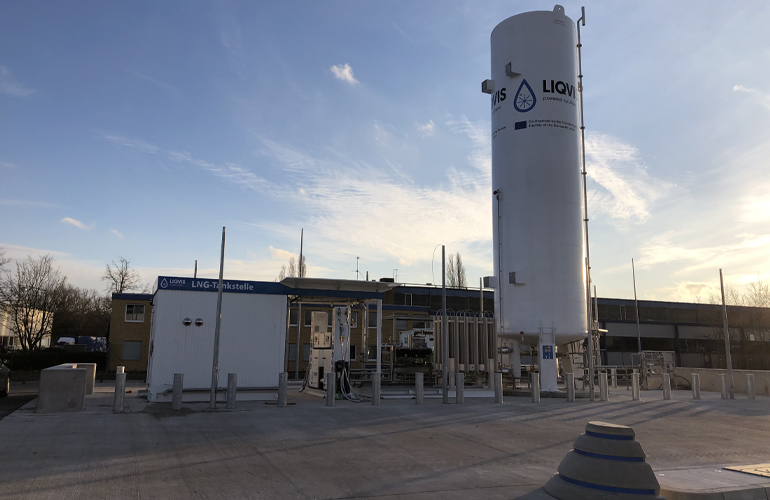
A subsidiary of energy major Uniper, LIQVIS has been operating LNG filling stations since 2017. These stations are located at strategic transport hubs that serve a particularly high volume of HGVs including Berlin-Grünheide, Hannover-Langenhagen, Kassel-Lohfelden, and Bönen.
To meet the increasing demand for this alternative fuel, a systematic expansion of the company’s German LNG filling station infrastructure is planned over the next few years. Examples of regions that will gain new LIQVIS stations this year as part of this expansion include Bad Honnef, Ulm-Seligweiler, and Magdeburg.
With low emissions of particulate matter (PM) and nitrogen oxides (NOx) compared to fossil diesel, LNG vehicles already meet the stringent environmental requirements of the Euro 6 emissions standard.
Fuel costs for larger HGVs weighing over 18 tonnes with an annual mileage of at least 100 000 km are also significantly lower than for diesel vehicles. Vehicles powered by LNG also offer a further advantage: they are exempt from motorway tolls in Germany.
The supply agreement with EnviTec is a major milestone on our way towards further decarbonizing the LIQVIS product portfolio. Since 2017, our conventional LNG products have been helping our customers make significant reductions to their carbon footprint when compared with the use of diesel fuel. Starting in 2022, our partnership with this established and experienced biogas generation company will also let us offer a fully carbon-neutral product at an attractive price for the very first time. As supplies of bioLNG have been limited in the past, it’s likely that we will not be able to meet customer demand in full initially. However, we are increasing the proportion of bioLNG in our portfolio as part of a continuous process that will ensure we can offer an attractive bioLNG product to all of our customers. If our efforts here are well-received by our customers, this would signal real progress towards decarbonizing heavy goods vehicle transport in Germany, said Sebastian Gröblinghoff, Managing Director of LIQVIS.
