

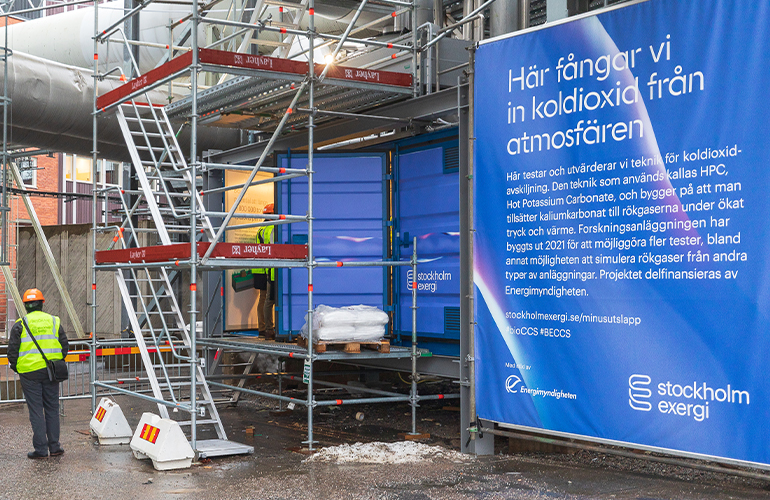
In Sweden, municipal energy major Stockholm Exergi AB has recently made it possible for its district heating customers to purchase negative emissions from the company’s future bioenergy with carbon capture (BECCS) facility. According to the company, the launch has received strong customer interest.
Please reload the page
Do you want to read the whole article?
- Six editions per year
- Full access to all digital content
- The E-magazine Bioenergy international
- And more ...
Alongside commitments to reduce emissions, more and more companies are seeing a need for negative emissions to reach net-zero targets or to further reduce their carbon footprint.
It is extremely exciting that we at Stockholm Exergi, together with our district heating customers, can contribute to realizing one of the most important new tools to curb global warming. District heating is a unique, shared resource that not only heats the people of Stockholm but also ensures the security of the local electricity supply. Now, district heating and its users can facilitate a way for companies and Sweden to reach their climate goals, remarked Anders Egelrud, CEO of Stockholm Exergi.
Help finance BECCS
Through their purchases, customers are simultaneously making additional contributions to the financing of Stockholm Exergi’s BECCS plant, which is scheduled to be operational in 2026.
The offering is available for all district heating customers who wish to purchase more than 1 000 tonnes of negative emissions per year over ten years.
The first companies to sign Letters of Intent (LoI) with Stockholm Exergi are Heba Fastighets AB, AMF Fastigheter, and Akademiska Hus.
Heba wants to be active in the development of how to minimize emissions that burden the climate. Reducing greenhouse gas emissions is one of Heba’s most highly prioritized goals. We are very pleased that we will also be able to purchase negative emissions with the help of BECCS and Stockholm Exergi in the future. We need to be at the forefront to ensure that Heba will go all the way to achieve net-zero emissions. This transition is absolutely crucial for the future, said Patrik Emanuelsson, CEO of Heba Fastighets.
Following the UN Intergovernmental Panel on Climate Change’s (IPCC) AR6 report from 2022, there is a global consensus that reducing emissions is not sufficient to meet the climate targets of the Paris Agreements.
In addition, extensive efforts are needed to reduce the concentration of carbon dioxide (CO2) in the atmosphere using various ways of achieving so-called negative emissions.
According to the IPCC report, BECCS plays a prominent role in securing these necessary negative emissions.
As one of Sweden’s largest property owners, we want to be part of driving the transition towards fossil-free energy use. The Letter of Intent with Stockholm Exergi brings us closer to our goal of being climate neutral in our entire value chain by 2035 and contributes to even more sustainable campuses, said Erik Florman, Sustainability Manager, Akademiska Hus.
More and more companies are becoming aware of climate challenges and have in recent years set targets to reach net-zero emissions in line with the Paris Agreement or earlier, often as early as 2030.
The climate issue and energy supply are one of the real estate industry’s most important sustainability challenges. We are therefore looking forward to participating in this project that will contribute to the development of new sustainable technologies in this field. The project is in line with AMF Fastigheter’s ambition to transition its operations to fulfill the 1.5-degree target, said Michael Eskils, Head of Sustainability AMF Fastigheter.
Achieving net zero requires companies to reduce emissions in their value chain as much as possible and then neutralize the remainder with precisely negative emissions.
The fact that our district heating customers see the need for negative emissions is very important. What we are seeing now is the beginning of a new market for negative emissions that will be central to financing BECCS facilities such as ours. If we resolve the financing and all the necessary regulations are in place, we expect to be able to take a decision on the investment in the first quarter of 2024, ended Anders Egelrud.
