


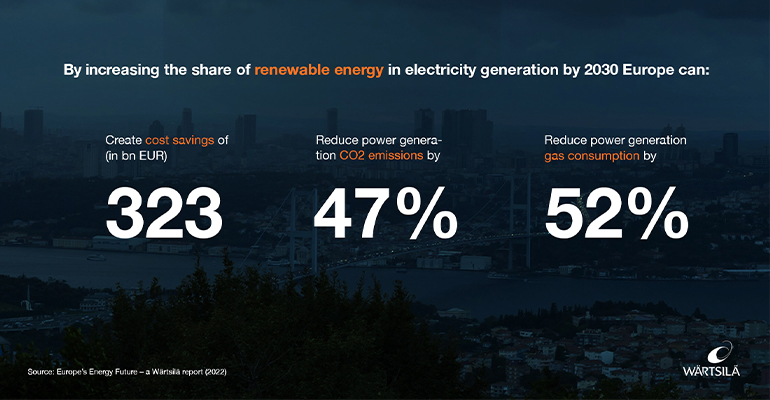
Europe can cut its power sector gas consumption in half, reduce energy costs by EUR 323 billion and increase energy independence by 2030 if it rapidly scales up its renewable capacity, according to a new report from Finland-headed marine- and energy engineering and technology major Wärtsilä Oyj.
To tackle the energy crisis and enable rapid decarbonisation, the technology company is calling on European leaders to implement a monumental but achievable level of cross-country coordination and investment to deliver up to 80 GW per year of renewable capacity, backed by flexible balancing technologies.
Reduce gas dependency and costs
The report, Europe’s Energy Future, demonstrates how accelerating renewables could also help solve the immediate energy crisis.
The ambitious approach modelled in the report would see renewable energy share in electricity generation increase from currently around 33 percent to over 60 percent by 2030.
Furthermore, it would have a direct impact on reducing electricity bills in the short and long term, potentially by up to 10 percent.
This approach could cut annual gas usage by the power sector by 52 percent across the continent by 2030.
This can enable the bloc to avoid 5 456 TWh of gas consumption, the equivalent of 3.5 years of Russian gas supply to the EU which is currently at around 1 600 TWh per year to Europe, or 40 percent of Europe’s need, significantly increasing energy independence.
The modelling of 33 European countries, including 27 EU member states, plus the UK, Norway, Switzerland and the Balkans, shows that if renewables are scaled up to 50 percent of the capacity mix by 2025 then Europe could save EUR 98 billion in energy costs.
Two scenarios
Wärtsilä modelled two scenarios for Europe’s energy transition over the coming decade noting that to provide baseload power, intermittent renewables such as wind and solar must be deployed alongside balancing technologies, such as energy storage and future-proof balancing engines capable of running on sustainable fuels.
The baseline scenario, based on the International Energy Agency’s (IEA) Renewables 2021 statistics shows European countries adding 40 GW of new renewables capacity every year until 2030 – in other words, the level of deployment currently seen in Europe.
This would achieve a 50 percent share of renewable power by 2030.
To reach the ambitious scenario modelled by Wärtsilä, European countries should collectively add an average of 80 GW of new renewable capacity, double the level of renewables currently added each year, to reach 61 percent renewable power by 2030.
Carbon emissions are also halved under the ambitious model, from 911 million tonnes of CO2 in 2021 to 479 million tonnes of CO2 in 2030. This reduction in CO2 emissions equates to nearly the entire 2020 carbon footprint of the UK.
Accelerating the transition to a clean energy system could save EUR 323 billion by 2030 compared to continuing the current pace of renewables growth. That is why we are calling for fast decisions to accelerate renewables, tackle the energy price crisis and enable rapid decarbonisation to avert the climate emergency. The time is now, ended Sushil Purohit.
