

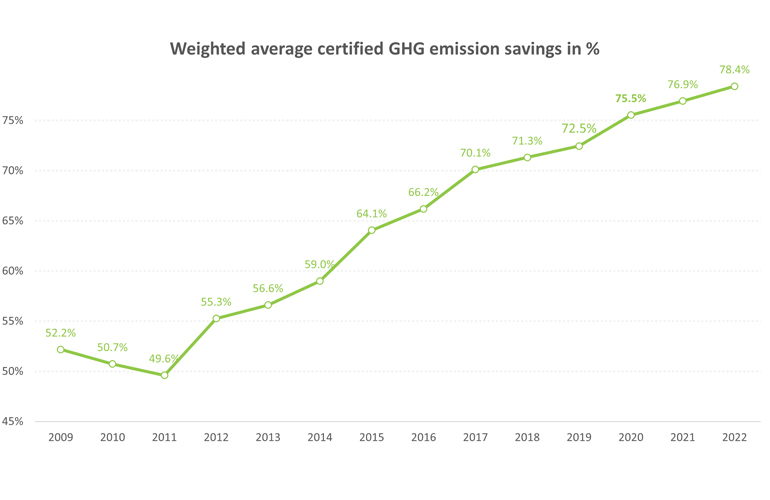
Renewable ethanol produced by members of the European Renewable Ethanol Association (ePURE) reduced greenhouse gas (GHG) emissions by more than 78 percent compared to fossil fuel in 2022, according to the latest audited producer data.
Please reload the page
Do you want to read the whole article?
- Six editions per year
- Full access to all digital content
- The E-magazine Bioenergy international
- And more ...
The production and use of renewable ethanol from ePURE members reduced greenhouse gas (GHG) emissions by an average of 78.4 percent compared to fossil fuels in 2022, according to new certified data.
The 2022 findings were compiled from ePURE members and certified by the auditing firm Copartner. It was the 11th consecutive year in which EU renewable ethanol increased its GHG-reduction score.
The record-breaking figure highlights the continuing innovation of the European renewable ethanol industry as biorefineries decrease emissions and improve the already impressive sustainability of EU crop-based and advanced biofuels.
Domestic production of EU renewable ethanol has never been more strategically important, contributing to Europe’s food security, energy independence, and transport decarbonization goals, said David Carpintero, Director General of ePURE.
More food than fuel
Once again, ePURE members produced more food and feed co-products than renewable ethanol – more food than fuel.
The record-high GHG-saving performance of ePURE members’ ethanol was accompanied by a significant production of food and feed co-products (5.9 million tonnes of commercial product) and of captured carbon dioxide (1.1 million tonnes) – more ways in which ethanol production contributes to EU food security and offsets fossil fuel use.
The new data comes as policymakers determine what role sustainable biofuels such as renewable ethanol can play in the drive for carbon neutrality.
Every year ePURE members improve their production processes with solutions that aren’t just on the drawing board but already deliver results now – including the capture of biogenic CO2 and increased production of food, feed, and fuel. This places Europe’s renewable ethanol industry as a world leader in terms of sustainability, ended David Carpintero.
