

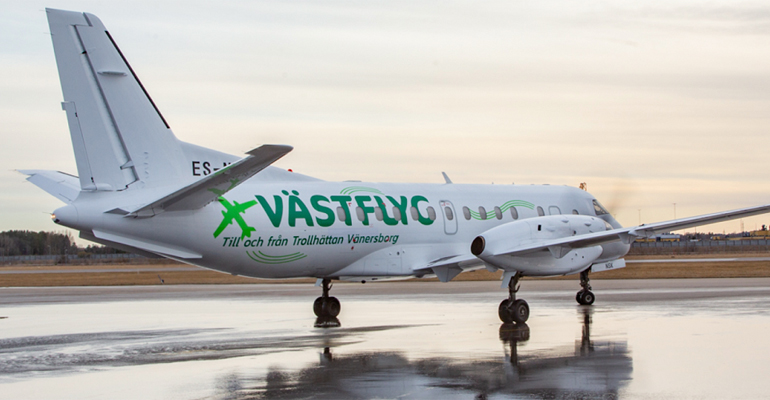
Sweden's Trollhättan-Vänersborg Airport (THN) in the southwestern part of the country, is to be the first airport in the world to offer only blended sustainable aviation fuel for all aircraft refuelling at the airport. Finland-headed oil refiner and renewable products major Neste Oyj will supply its Neste MY Sustainable Aviation Fuel to the airport in a 30-40 percent blend with conventional jet fuel.
Please reload the page
Do you want to read the whole article?
- Six editions per year
- Full access to all digital content
- The E-magazine Bioenergy international
- And more ...
Trollhättan-Vänersborg Airport (THN) will make the blended sustainable aviation fuel (SAF) available for refueling for all departing flights by the end of June this year. This will significantly reduce greenhouse gas (GHG) emissions of departing flights.
With our investment into SAF, we wish to accelerate the transition to a more sustainable aviation industry. Together with Västflyg and Neste, we want to inspire and pave the way for a more sustainable future for the aviation industry, said Anna Råhnängen, Airport Manager at Trollhättan-Vänersborg Airport.
Västflyg AB, a Swedish regional commercial airline, will be the first airline to power all its flights with this SAF fuel. This includes regular routes between Trollhättan and Stockholm Bromma Airport (BMA) as well as Visby Airport (VBY) on the Island of Gotland and all its charter flights from Trollhättan.
The aviation industry is a necessary part of a well-functioning society but according to all calculations, air travel is expected to double in the next 15 years. This means that also aviation-related emissions will increase. By using a high blend of SAF, we will immediately reduce our GHG emissions for all flights, explained Anna Petre, CEO of Västflyg.
Cuts GHG emissions by up to 80 percent
SAF is a renewable aviation fuel providing a more sustainable alternative to conventional, fossil-based jet fuel.
With unblended Neste MY Sustainable Aviation Fuel, GHG emissions can be reduced by up to 80 percent over the fuel’s life cycle, compared to using conventional jet fuel, calculated with established life cycle assessment (LCA) methodologies, such as Carbon Offsetting and Reduction Scheme for International Aviation (CORSIA) methodology.
Current jet fuel certifications allow SAF to be used blended up to a maximum of 50 percent with conventional jet fuel.
According to Neste, its SAF is made from sustainably sourced, 100 percent renewable waste and residue raw materials, such as used cooking oil (UCO) and animal fat waste.
SAF is widely recognized as a key lever to reach aviation’s emission reduction goals. Trollhättan-Vänersborg Airport and Västflyg have taken a big and important step to use blended SAF to refuel aircraft for all departures. It shows their commitment to reducing the greenhouse gas emissions of air travel and sets an example for other airports and airlines across the world to follow, said Alexander Kueper, VP EMEA of the Renewable Aviation business unit at Neste.
