

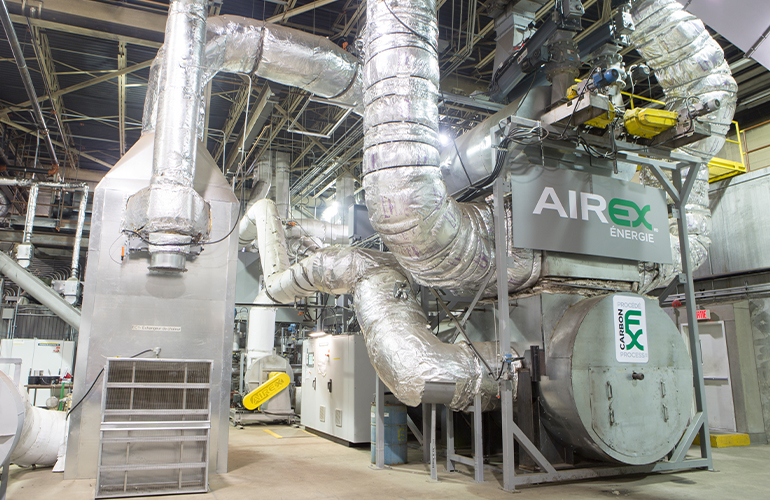
In February 2017, Canada-headed Airex Energy officially inaugurated its biomass torrefaction demonstration plant in Bécancour, Québec (QC) following a 14-month gradual testing and commissioning of the plant’s equipment to optimize its proprietary ”CarbonFX” torrefaction process. Fast-track to February 2023, and the company is on the cusp of commercial rollout as Michel Gagnon, CEO of Airex Energy explains.
Please reload the page
Do you want to read the whole article?
- Six editions per year
- Full access to all digital content
- The E-magazine Bioenergy international
- And more ...
Much biomass has been torrefied by Airex in Bécancour since the demonstration plant was first completed in December 2015.
Located in the La Prade industrial park in Bécancour, a key feature of the CarbonFX technology is that it can process a range of feedstock such as sawdust, bark, shavings, woodchips, recycled wood, forest- and agriculture residues to produce a variety of outputs.
Furthermore, the ability to precisely control different process parameters such as temperature and residence time means that the carbonized output can be tailored for different end-use purposes while maintaining the quality, consistency, and homogeneity of the product.
This includes torrefied material for energy or use in composites, activated carbon for the filtration of fluids and gases, metallurgical grade biocoke for use as a reduction component in steel and silicium manufacturing, or biochar for use in agriculture, gardening, and horticulture.
For the latter, Airex has tested and received approval from the Canadian Food Inspection Agency for the sale and use of its BiocharFX agri-products in Canada though these are not being produced.
Aligned for scale-up and rollout
Thus, the Airex demo plant has evolved to become a commercial plant, and for some time now the two-tonne per hour facility is operating 24/5 supplying clients with product, and potential clients with test volumes.
The organization too has expanded, not least with the appointment of Michel Gagnon as CEO some twelve months back, a person from outside of the biomass/torrefaction bubble to take the company to the next level.
I’m a numbers and deployment guy – my background is finance and large-scale industrial project deployment and scale-up, most recently from the metallurgy industry, said Michel Gagnon by means of introduction, clarifying as a matter of record that frontman and co-founder Sylvain Bertrand is the COO, and co-founder colleague Guy Prud’homme is the CTO.
Partnership with SUEZ Group
A key milestone for Airex is the partnership with the global waste management and resources major SUEZ Group, first announced in June 2021.
Our business model is to build, own, and operate green carbon production plants, in collaboration with partners. Therefore, we are very happy with our partnership with SUEZ Group to boost the deployment of our CarbonFX technology on a global scale. The partnership is developing very well. In fact, our first joint project within the partnership is here in Québec, and is advancing into the construction phase, revealed Michel Gagnon.
The agreement with SUEZ is for the development of the biochar and carbon sequestration market. The target is to reach a production capacity of 350 000 tonnes of biochar and over one million carbon removal credits by 2035.
With twelve years to go, it would seem an ambitious target – a napkin calculation based on the Bécancour plant, say 15 000 tonnes per annum (tpa), would mean the rollout of 23 plants by 2035, two per year.
And that is without considering other projects in the Airex pipeline.
The Bécancour plant produces 15 000 tpa of biocoal using the CarbonFX technology, and while Airex has completed the design and engineering of a 5 tonnes per hour unit, the CarbonFX 5TPH, it too is for biocoal production. The agreement with SUEZ is biochar production, and the aim is to build plants in the 20 000 – 30 000 tpa range. For these, we will use the CarbonFX HT technology as it is optimized for large-scale biochar and biocarbon production, and features a new carbonization technology. At that production level, we will need to build at least 11 plants to cope with the 350 000 tonne biochar objective, ended Michel Gagnon without disclosing further details about this new Airex technology.
In other words, watch this space.
