

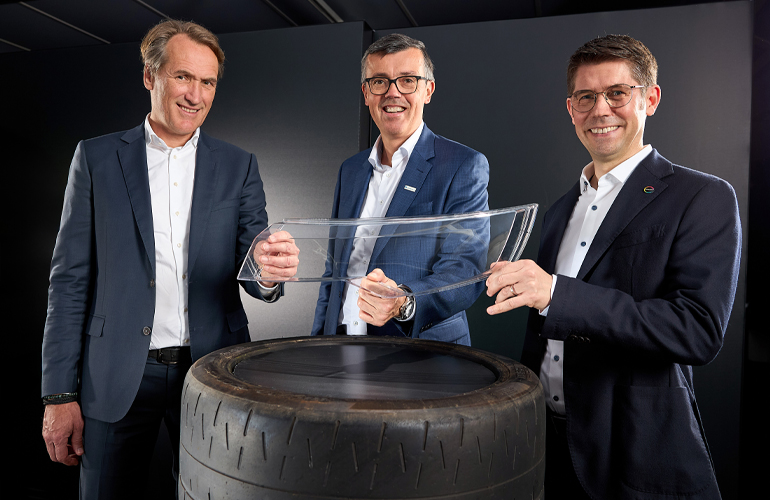
In Europe, Austria-headed advanced and sustainable polyolefin solutions provider Borealis AG, Germany-headed polymer major Covestro AG, and Finland-headed oil refiner and renewable products major Neste Oyj have signed a project agreement to enable the recycling of End-of-Life tyres (ELTs) into high-quality plastics for automotive applications.
The collaboration aims at driving circularity in plastics value chains and the automotive industry.
When no longer fit for use, tyres are liquefied by means of chemical recycling and then processed into base chemicals and further into polycarbonates of high purity.
These can then be used in various automotive applications, from parts of headlamps to radiator grilles.
Circularity requires cooperation, and this cooperation with our partners Neste and Borealis is a testament to the possibilities at our disposal. We are creating options to turn discarded materials from cars into new car parts again. With that, we are supporting our automotive customers and addressing an increasingly prominent question discussed across the value chain: How to match high-performance materials with recycled content? Projects like this can be the answer, said Guido Naberfeld, SVP, Head of Sales and Market Development Mobility at Covestro.
First products already available
As part of the collaboration, Neste turns liquefied discarded tyres into a high-quality raw material for polymers and chemicals manufacturing and supplies it to Borealis.
Borealis will then process the Neste-produced raw material into base chemicals phenol and acetone, which are supplied to Covestro. Covestro can use these materials to make polycarbonates.
The share of recycled content is attributed via the mass balancing approach all the way to the final products using ISCC Plus certification.
We are demonstrating the importance of value chain cooperation to give new value to waste. We are proud that Borealis, in collaboration with Neste, is able to play a role in this project, providing more sustainable solutions for polymer applications for Covestro and its customers, said Thomas Van De Velde, SVP of Base Chemicals at Borealis.
The first products based on the collaboration are already available as each party has manufactured the first batch of their respective contribution to the project.
Aside from polycarbonates, the project partners may also consider polyurethanes as a possible end product, which could also find its way into parts of the interior of a car.
The companies emphasize that the potential to scale up these types of developments should be considered when setting ambitious targets for future EU regulations, such as the End-of-Life Vehicles Regulation (ELVR).
This project can serve as a blueprint when it comes to establishing circularity in the field of plastics in cars. It shows how low-quality waste materials can be turned into very high-quality plastics. This is good news for the polymers and automotive industries as well as for the environment, said Jeroen Verhoeven, VP of Value Chain Development for polymers and chemicals at Neste.
