

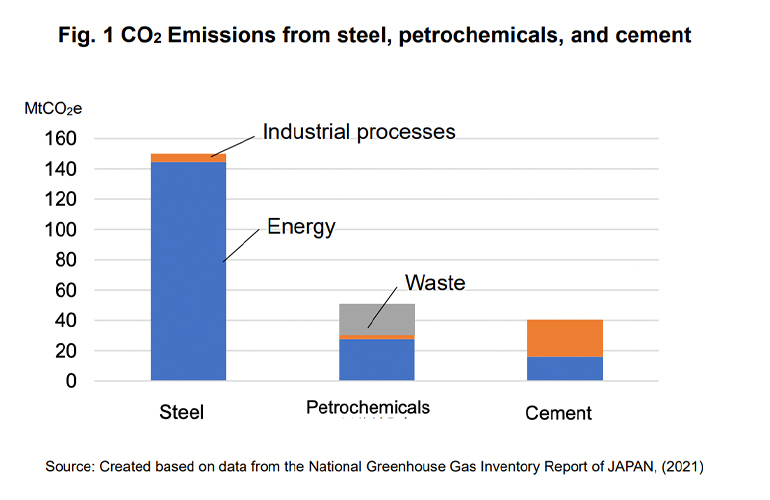
In Japan, the Renewable Energy Institute (REI), a non-profit independent think tank, has released a new report outlining a possible pathway for the decarbonization of the country's petrochemical industry, the second largest industrial sector source of carbon dioxide emissions.
The petrochemical industry has long been seen as a “hard-to-abate” sector, but to meet the 1.5°C goal, this sector needs to be decarbonized without delay.
Energy-related emissions from Japan’s petrochemical industry total 27.6 million tonnes of carbon dioxide equivalents (CO2eq) per year.
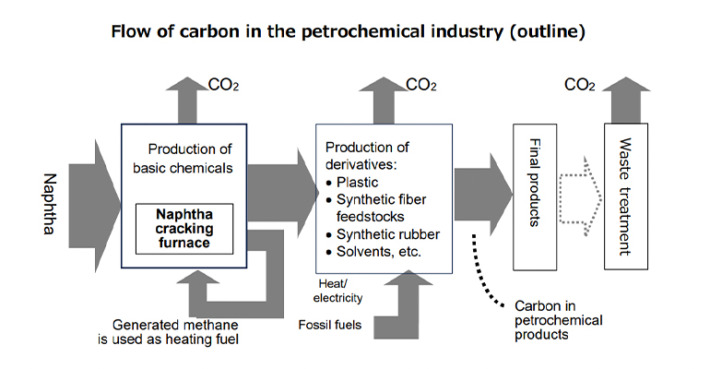
In addition, petrochemical products are composed primarily of carbon from fossil fuels, so the incineration of waste petrochemical products, even after taking into account energy recovery, generates 19.8 million tonnes CO2eq of emissions per year.
Another 1.7 million CO2eq of emissions are generated by the incineration of volatile organic compounds (VOCs) recovered from facilities that use solvents.
Need to switch mindset
The main objective of this REI report is to provide a “big picture” of the action needed to decarbonize the petrochemical industry and petrochemical products.
According to the report ‘Pathway to Decarbonization of Petrochemicals in Japan: Shifting from Mass Consumption, Creating Carbon Circulation and Enhancing Renewable Energy Deployment‘, originally published in Japanese on December 12, 2023, various technologies capable of achieving near-zero CO2 emissions are rapidly being developed.
The challenge has more to do with the lack of a shared vision of the future among the many stakeholders that need to collaborate on the decarbonization of petrochemicals.
According to the report, the Japanese petrochemical industry is currently set for a period of major restructuring.
This anticipated restructuring needs to be used as an opportunity to promote the phasing out of fossil fuels and decarbonization of the petrochemical industry.
The REI report shows that decarbonizing the petrochemical industry and its products will require a collaborative effort from various stakeholders across the value chain, not limited to those directly involved in the industry.
The report highlights prominent European measures and presents eight recommendations for future policy focus.
We hope that this report will stimulate interest in decarbonizing the industrial sector and promote the transition from a society centered on mass consumption to one focused on sustainable consumption and production, notes REI.
