

Swedes seem to have a better understanding of the contribution of bioenergy to the country's energy system. At least when compared over the last decade according to an annual opinion poll conducted by Kantar Sifo on behalf of the Swedish trade publication Tidningen Bioenergi. The poll, carried out during the second week of February 2020 has asked the same question once a year since 2010 to the Swedish public: What percentage of Sweden's energy use do you think bioenergy accounts for?
For the eleventh year in a row, Tidningen Bioenergi – a Swedish trade publication owned by the Swedish Bioenergy Association (Svebio) – has commissioned Kantar Sifo to ask the same question to the Swedish pubic: What percentage of Sweden’s energy use do you think bioenergy accounts for?
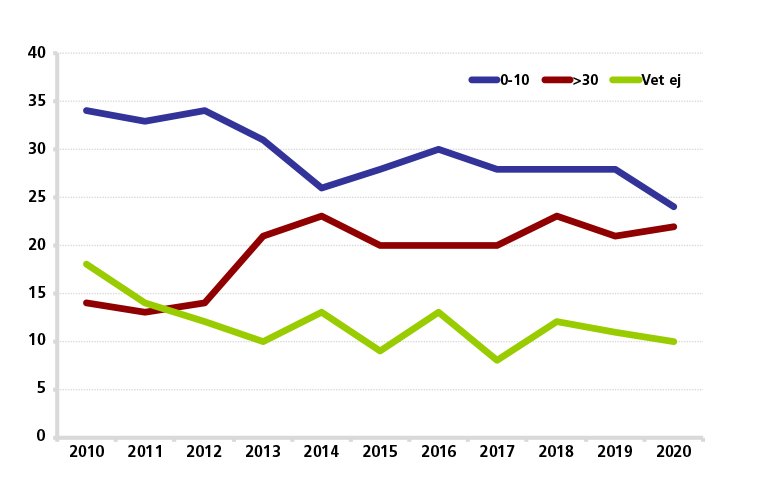
The purpose of the opinion poll is to get an idea of how Swedish citizens assess the share of bioenergy in the Swedish energy system. In the early years of the poll, the proportion that answered correctly or almost correctly increased and the proportion that answered most incorrectly decreased.
At the same time, the percentage that was “unsure/don’t know” also decreased.
More accurate responses
According to Anders Haaker, Editor in Chief, the changes have been small over the last five years. However, this year, there is a clear decrease in the proportion that responded most inaccurately – those who responded that bioenergy accounts for ten percent or less decreased from 28 percent in 2019 to 24 percent in 2020.
The proportion that answered most correctly increased by one percent from 21 to 22 percent in the past year, and an increase of eight percent since 2010.
This is the lowest percentage since we began polling, and is a decrease of ten percent compared to 2010, said Anders Haaker.
The share that is “unsure/don’t know” has fluctuated around ten percent since 2013. Both this year and last year the share of “unsure/don’t know” fell and this year is at just ten percent.
Female respondents more correct but less confident
From the results, it is possible to compare the answers based on the persons’ gender, age, political sympathies, level of education, employment, place of residence and more. It is clear that female respondents generally are more correct.
Of male respondents, 33 percent replied that bioenergy is less than ten percent, while only half the percentage of female respondents (16 percent) were equally incorrect.
28 percent of females responded that bioenergy accounts for more than 30 percent, while only 16 percent of males gave this response. In addition, fewer males are unsure: seven percent versus 13 percent for female respondents.
Male respondents would seem more confident in their response but are more likely to be wrong and vice versa for females.
Right direction
Bioenergy is omnipresent in Sweden’s energy mix – found in heat. power and transportation fuels – and consists of biomass fuels such as woodchips, wood pellets, waste, biogas, HVO and ethanol to mention a few.
The poll shows that the majority of respondents still answer incorrectly – the correct answer being that bioenergy accounts for 38 percent of Sweden’s final energy use (2018).
However, this year’s poll shows a more positive trend than last year’s poll and is something to be pleased about. Perhaps this is a result of mainstream media channels recruiting more journalists to cover the climate issue and that climate and energy policy received more attention during the past year. Knowledge of facts about the role of bioenergy in the Swedish energy system seems to have increased somewhat, ended Anders Haaker.
Facts
About the poll
The question was asked in the second week of February 2020 in Kantar Sifo’s phone survey 1 000 respondents, 506 male and 496 female (who were then weighted). The question was: What percentage of Sweden’s energy use do you think bioenergy accounts for? The respondents had to provide a percentage themselves.
