

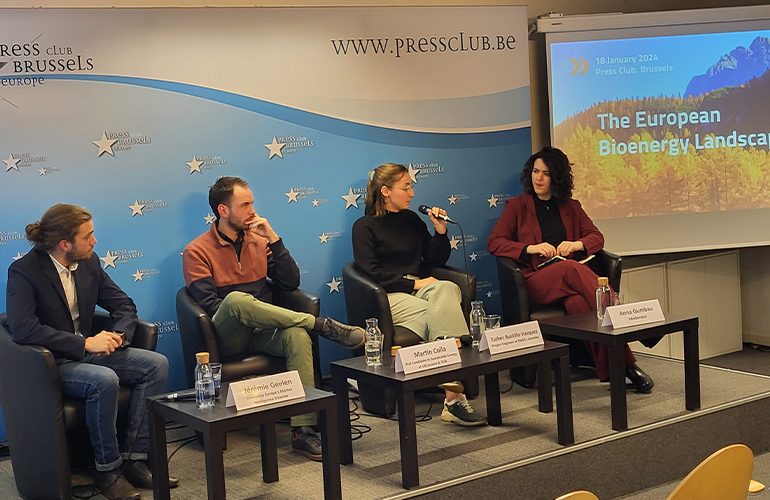
At COP28 world leaders agreed on the need to break free from fossil fuel dependency and triple production of renewable energy by 2030. Bioenergy is Europe’s leading source of renewable energy but could do more as participants at a Bioenergy Europe briefing that shed light on the significance of bioenergy in the European Union's decarbonization journey.
Held on January 18, 2024, in Brussels, Belgium, Jérémie Geelen, Bioenergy Europe’s Market Intelligence Director, presented details of the Association’s most recent statistical report, ‘Bioenergy Landscape‘ that was released in December 2023.
Currently, imported fossil fuels remain the main source of energy in the EU. At COP28 world leaders agreed on the need to break free from fossil fuel dependency and triple production of renewable energy by 2030.
Primarily produced in Europe, bioenergy represents a versatile renewable that can be used for heating, transport, and electricity and is Europe’s leading renewable source.
Heating represents most of our energy demand. To reach climate neutrality by 2050 it is key to decarbonize the sector, Bioenergy takes the lead, contributing a substantial 83.6 percent to the EU’s renewable heating mix. Its standout features—versatility, indigenous supply, and independence from weather conditions — position bioenergy as a leading solution in the renewable heating landscape, stated Jérémie Geelen, Market Intelligence Director, Bioenergy Europe.
During the event, speakers presented different perspectives on bioenergy potential to push forward the energy transition.
The energy transition confronts us with the imbalance of our actions on the ecosystems on which we rely. The use of biomass for energy has highlighted the relationship between humans and nature and the renewal cycle of natural resources, raising awareness on sustainable practices and environmental protection of ecosystems, highlighted Martin Colla, PhD Candidate in Sustainable Energy, UCLouvain & VUB.
Speakers agreed that bioenergy and electrification are complementary and not competing, bioenergy is a crucial source of energy for households, especially those with lower incomes, and it has unique characteristics that Europe needs to achieve neutrality.
Bioenergy is not only the most versatile renewable energy solution but also a viable option for hard-to-abate sectors like heavy industry and transportation. In essence, bioenergy is not just part of the solution; it is a key player in creating a cleaner, greener future for us all, declared Esther Bustillo Vazquez, Project Engineer, ENGIE Laborelec.
To assist the EU in its decarbonisation efforts Bioenergy Europe has outlined three steps towards the energy transition on its Manifesto for the 2024 European Elections.
