

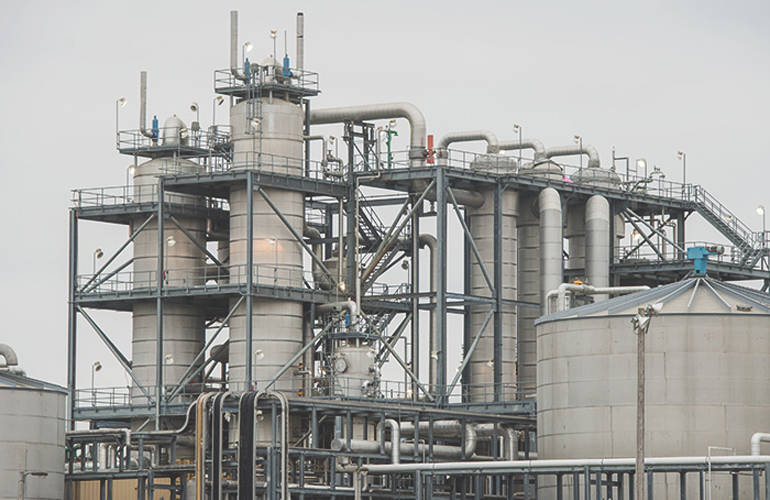
In the United States (US), Fluid Quip Technologies LLC (FQT), a majority-owned subsidiary of corn ethanol producer Green Plains Inc. has launched its "DCO+", new technology to achieve "record-high low-carbon" renewable corn oil recovery in dry-grind corn ethanol facilities.
FQT has commercialized multiple technologies to enhance the base corn-to-ethanol dry grind process, create new and novel alternative feed products, and supply the growing need for carbohydrate feedstocks in the biochemical market.
In early 2021, Green Plains acquired a majority shareholding in the company as part of strategic investments to significantly transform its business from an ethanol and commodities processor to a leading technology-focused and innovative producer of sustainable, value-added ingredient solutions.
According to a statement, a recent full-scale demonstration of DCO+, installed at Green Plains Wood River ethanol facility in Wood River, Nebraska (NE), has achieved a breakthrough 1.4 pounds per bushel low-carbon renewable corn oil yield when integrated into a full FQT MSC system.
As a standalone system, DCO+ can achieve up to a 40 percent increase in the overall production of corn oil.
FQT will offer this valuable solution to other ethanol plants throughout the industry.
Developed from protein separation
DCO+ utilizes FQT’s patented technologies to liberate additional distillers’ corn oil from the fiber fraction in the distillers’ grains.
The DCO+ technology was born from FQT’s patented MSC protein separation system and is integral to the high corn oil yields those systems produce.
This new renewable corn oil capture technology comes from years of experience operating our MSC systems and is an immediate game-changer for Green Plains and for the industry, said Michael Franko, Managing Director, Fluid Quip Technologies.
The technology encompasses a multi-stage fiber washing with thin stillage clarification.
A series of washing and clarification steps provide additional opportunities for the corn oil to be separated from the fiber for collection by the plant’s existing oil recovery system.
Centrate from the fiber washing is sent to a final separation step to partition free oil from residual solids, producing an evaporator feed high in oil and low in suspended solids.
With DCO+, independent plants looking for low-cost revenue-enhancing projects can take advantage of up to 40 percent more corn oil, a valuable low-carbon feedstock for the rapidly expanding renewable diesel industry, ended Michael Franko.
