

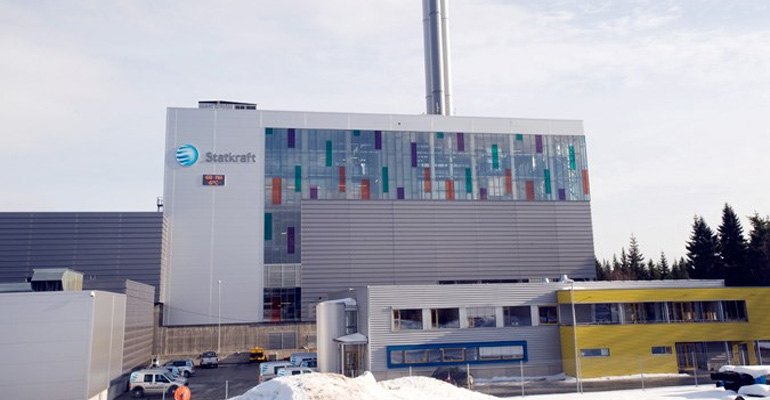
Norway-headed pure-play carbon capture company Aker Carbon Capture AS has announced that it has been awarded a pre-Front End Engineering Design (pre-FEED) for compatriot Statkraft’s Heimdal waste-to-energy (WtE) plant for capturing 220,000 tonnes of carbon dioxide (CO₂) annually.
As previously announced, Aker Carbon Capture is one of three companies selected in the pre-FEED stage which covers carbon dioxide (CO2) capture, compression, purification, liquefaction, and temporary storage of CO2 at the Heimdal waste-to-energy plant.
From Heimdal, the liquid CO2 will be transported by truck to an export terminal with subsequent ship transport to permanent storage.
By capturing and permanently storing these emissions, it is possible to reduce up to 25 percent of Trondheim municipality’s CO₂ emissions.
We are excited to extend our collaboration with Statkraft. The decarbonization of the waste-to-energy industry is crucial in achieving Norway’s ambitious climate goal of reducing greenhouse gas emissions by 55 percent by 2030. By leveraging our product portfolio and ongoing projects, we maintain a robust position within the waste-to-energy sector, said Jon Christopher Knudsen, Chief Commercial Officer at Aker Carbon Capture.
In 2023, Aker Carbon Capture was awarded a full FEED by Hafslund Oslo Celsio, the largest supplier of district heating in Norway, to develop carbon capture at their waste-to-energy facility at Klemetsrud in Oslo.
The project will be delivered based on Aker Carbon Capture’s modularized Just Catch 400 unit, with a design capacity to capture up to 400,000 tonnes of CO2 annually.
Waste-to-energy with CCS is climate-efficient
Treating waste in a modern incineration plant is the most climate-efficient way of final treatment when the waste has no other utility value. However, waste incineration emits large volumes of CO2.
District heating from Statkraft’s waste-to-energy plant at Heimdal provides more than 30 percent of the Trondheim municipality’s heating demand. District heating reduces the amount of electricity needed, making more electricity available for other purposes.
Together with the direct carbon reduction and removal when these emissions are captured, waste-to-energy facilities serve as an important part of Norway’s journey towards net zero.
Statkraft is also a member of ‘CCS Midt-Norge’, an industry cluster for CO2 capture and storage in central Norway, representing about 1.5 million tonnes of annual CO2 emissions.
The cluster is expected to lead to an increased understanding, progress, and potential economies of scale related to the realization of CCS in the region.
