

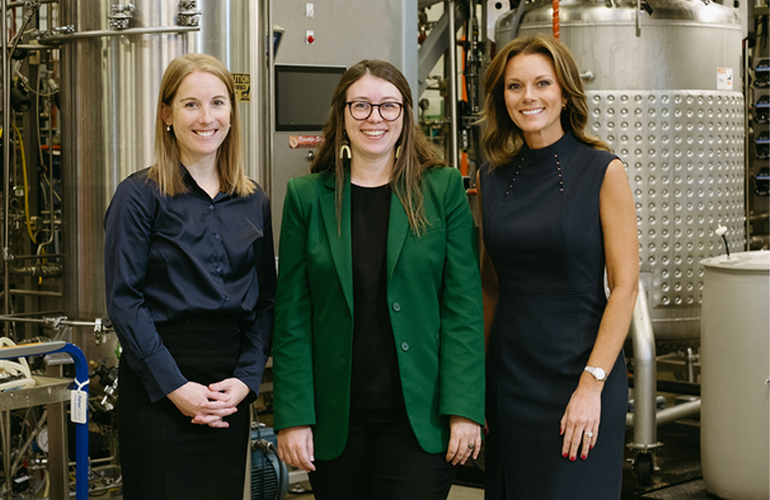
In the United States (US), the Illinois Fermentation and Agriculture Biomanufacturing Tech Hub (iFAB) has announced almost US$680 million in commitments from partners — to be catalyzed by potential funding from the US Economic Development Administration (EDA) — at a press conference hosted by Governor J.B. Pritzker and Innovate Illinois in the Integrated Bioprocessing Research Laboratory (IBRL) at the University of Illinois Urbana-Champaign.
The Illinois Fermentation and Agriculture Biomanufacturing Tech Hub (iFAB) is uniting world-class R&D, industry leaders, innovative startups, scalable infrastructure, feedstock production, transportation networks, and relationships with corn and soybean suppliers within a 51-mile radius in a unique “lab-to-line” approach to establish the iFAB region (Champaign, Piatt, Macon counties) as the preeminent destination for the biomanufacturing industry.
It is one of 31 Regional Innovation and Technology Hubs in the United States that qualify for US$45 to US$70 million in Phase 2 Implementation grant funding from the EDA, which was made possible by the bipartisan Creating Helpful Incentives to Produce Semiconductors (CHIPS) and Science Act of 2022 to spur innovation and job creation and ensure national security in the U.S.
The iFAB consortium — led by the Integrated Bioprocessing Research Laboratory (IBRL) with 31 partners from academia, industry, government, and nonprofits — has submitted a proposal to catalyze biomanufacturing and precision fermentation industry growth in Champaign, Piatt, and Macon counties.
The Tech Hub designation, announced in October 2023, has spurred our iFAB partners to commit US$680 million to realize our vision for Illinois to become the heart of biomanufacturing. With the EDA’s support, we can lock in thousands of jobs and secure billions in market potential, said iFAB principal investigator Beth Conerty, Associate Director of Business Development at IBRL, part of the College of Agricultural, Consumer and Environmental Sciences (ACES) and The Grainger College of Engineering.
Support a growing biomanufacturing entrepreneurial ecosystem
iFAB partner contributions include cash match and strategic investments — including cash matches from a third of consortium members and infrastructure upgrades valued at US$118 million that will benefit biomanufacturing projects in Decatur.
The Phase 2 Implementation grant funding would support the growing biomanufacturing entrepreneurial ecosystem, critical infrastructure projects for lab space and multi-use facilities, and much-needed workforce development training programs led by Parkland College and Richland Community College and initiatives led by the Plumbers & Pipefitters Local 149 and the Decatur Building & Construction Trades Council.
The Economic Development Corporations (EDC) in Champaign County and Decatur & Macon Counties, the Illinois Department of Commerce and Economic Opportunity (DCEO), and Intersect Illinois are ready to leverage these initiatives to attract more companies to the region.
Precision fermentation is a growing area of biomanufacturing that turns corn and soybeans into textiles, biofuels, food ingredients, polymers, pigments, and more. This sustainable, scalable, and biological manufacturing process relies on microbes to convert sugars into high-value products.
The precision biomanufacturing industry is bringing revolutionary change to everything from how we feed the world to how we actually manufacture that world — in sustainable and clean ways. This is expected to become a US$200 billion industry that creates one million new jobs within the next 15 years alone, and as the iFAB proposal has laid out so clearly, there is no place on this planet better positioned to be the heart of that global industry than right here in downstate Illinois, said U of I Chancellor Robert J. Jones at the press conference.
Following the press conference, Congresswoman Nikki Budzinski and DCEO Director Kristin Richards hosted an exclusive roundtable event with iFAB consortia members to discuss the future of the project.
Current estimates project that the global precision fermentation capacity must increase by 20 times to meet projected demand, specifically in food and materials markets. Illinois’s strategic location, wide-ranging expertise, and existing infrastructure make it an ideal location for industry growth.
