

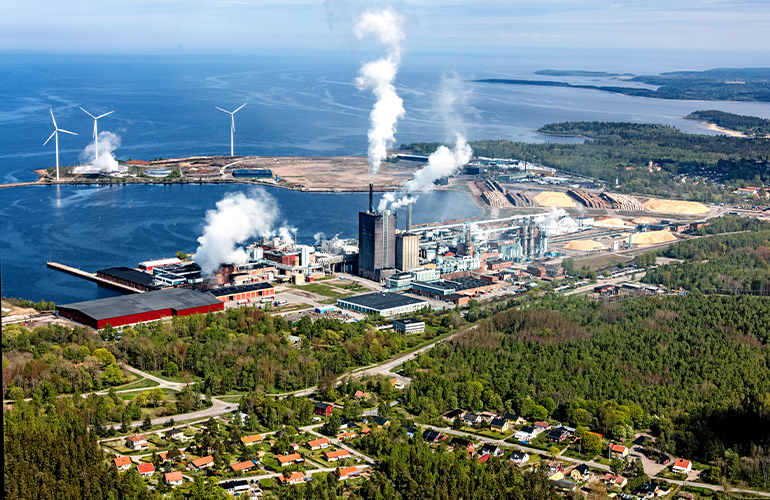
In Sweden, Stora Enso’s Skutskär biomaterials production site focuses on the production of fluff pulp for absorbent products such as diapers and other daily needed hygiene products, as well as producing innovative biomaterials using all parts of a tree. Already 100 percent powered by biomass, the recent start of a carbon capture pilot marks the next development step toward carbon-negative products for Stora Enso.
Stora Enso’s Skutskär site has a long history of continuously reducing the environmental footprint of its operations and products.
In 2019 it had phased out the use of fossil fuels in its operations meaning that all the energy – heat and power – produced at the site are based on biomass fuels.
The next step towards climate-positive operations in Skutskär is the start of a pilot for capturing biogenic carbon dioxide (CO2) from pulp production.
The recently started pilot unit captures CO2 emissions from these biomass fuels, and it is the first project in the world where the CO2-capturing equipment has been installed in a recovery boiler unit of a pulp production site.
As the largest producer of fluff pulp in Europe, the Stora Enso Skutskär biomaterials production site is paving the way towards carbon-negative products.
Part of the ACCSESS project
The pilot at Stora Enso Skutskär is part of the EU-funded ACCSESS project, a four-year Horizon 2020 project coordinated by Norway’s SINTEF Energy Research to demonstrate technologies and produce tools and plans that enable widespread carbon capture and storage (CCS) deployment in Europe.
Consisting of 18 partners, including Stora Enso, from eight different countries the ACCSESS project consortium investigates carbon dioxide removals (CDR) in four industrial sectors: pulp and paper, cement, waste-to-energy (WtE), and biorefineries.
The ACCSESS test rig has been successfully moved to and installed at Stora Enso’s pulp and paper mill in Skutskär, Sweden for the next round of carbon capture testing.
It comprises Hafslund Oslo Celsio’s pilot testing rig, CO2 solutions by Saipem enzymatic carbon capture technology with a Prospin and Proceler’s Rotary Packed Bed (RPB) absorber, and mineralization of industrial alkaline waste.
By developing carbon dioxide capturing chemistry and technology to reach cost-efficient storage of CO2 at a large scale and support society to reach net zero and minimize climate warming.
Another project feature is the techno-economic, regulatory, and environmental analysis of CO2 capture, transport, and storage chains.
We have successfully phased out the use of fossil fuels at our biomaterials production site. As a next step, we are delighted to be part of the ACCSESS project and test the carbon capture equipment, to further investigate the possibilities to reduce the environmental footprint of our operations and products, said Christer Nordstrand, Director of Stora Enso’s Skutskär production site.
Two tonnes per day
The pilot plant at the Skutskär site aims to reach two tonnes of captured carbon per day, and one of the goals is to operate the pilot using only low-temperature waste heat from the site.
To make full-scale carbon capture installation viable in the future, some technical issues need to be thoroughly evaluated in the ACCSESS project.
In addition, whether the captured carbon will be stored or utilized in the future depends on many open topics.
At the Skutskär production site, the chemistry and energy integration part of the biogenic carbon value chain is tested, however, the storage or utilization of the captured carbon is not part of this project.
